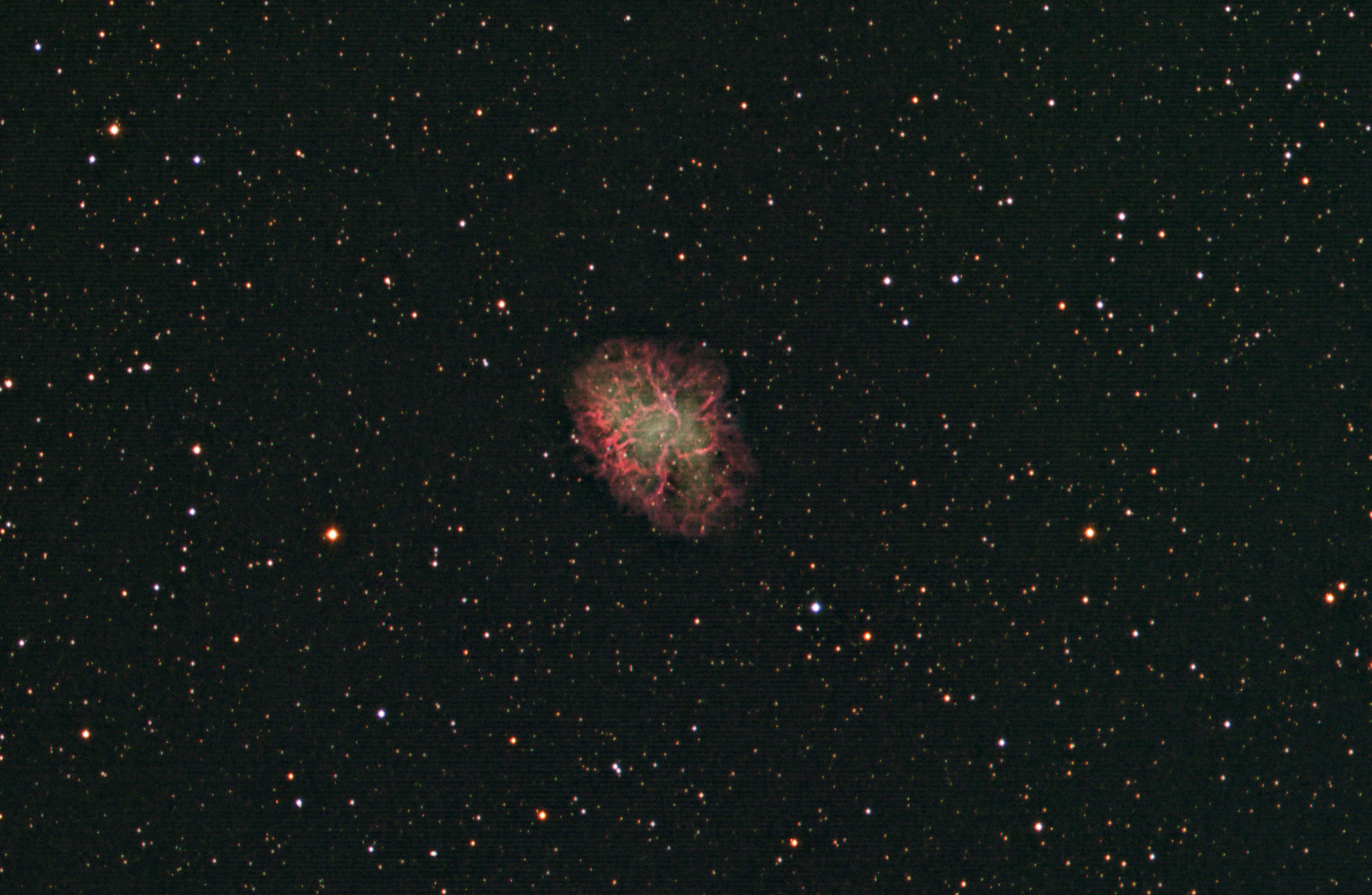
DESCRIPTION: The Crab Nebula was first identified in 1731 by John Bevis, but it has been mis-identifed as a comet. The discovery that is was not moving and not a comet came in 1758 by Charales Messier. This object is another super nova remnant, and was the first object to be recognized as a super nova. Their is historical observasion of this super nova exploding buy Chineese astronomers back on july 4th 1054 in which the newly discovered star was visable during the daytime, their may also be Japanese observations also during the same time. At the center of this nebula is a pulsar, which is the remnant of the explosion, it is approx. 17-19 miles in diameter, and is spinning at a rate of 30.2 times a second. It emits all wavelenghts of radiation and is the brightest persistant source of gamma-rays in the sky.
LOCATION: Raleigh, North Carolina
DATE: 02/02/2019 9:28PM
SCOPE: William Optics 5.2" FLT132 f/7
CAMERA: SBIG SFT-8300M CCD
EXPOSURE: 13x600sHa, 13x600sOIII, 17x600sSII, 7 hour 10 minute total exposure.NOTES: This was the first time I experimented imaging and post processing using the Hubble Palette. All images are shot in narrow band (Ha, OIII, SII), and process in color with Red=Ha, Green=SII, and Blue=OIII. I was impressed it was as easy as it was to process and will be attempting this again soon with more images of the Eastern Vail, and other nebula.